A note on this analysis: This analysis is written from Ethos Chain's Dubai office. It engages directly with controversies surrounding the host state's role in Sudan and adjacent African contexts. The firm addresses that conflict at the front of the piece.
The Gulf states did not discover Africa in the aftermath of the 2026 war. The capital, port, mineral, and agricultural positions now drawing fresh attention have been under construction since well before the Strait of Hormuz closed. What the war has supplied is geopolitical permission to accelerate a strategy already in motion, while simultaneously surfacing the political, governance, and reputational risks the strategy has yet to demonstrate it can manage. The more interesting question is whether the institutions executing it can pass the tests the next phase will impose.
Acceleration, Not Discovery
The largest single Foreign Direct Investment in Egyptian history, ADQ's 35 billion US dollar Ras El Hekma development on the Mediterranean coast, was finalised in February 2024, more than two years before any missile fell on Ras Laffan. The Saudi Public Investment Fund's mining vehicle Manara, established as a joint venture with Ma'aden with the headline ambition of deploying capital into international mineral assets, was announced in early 2023. DP World's African terminal portfolio has been under construction since the 2006 acquisition of P&O. The Saudi Fund for Development, the Abu Dhabi Fund for Development, and the Kuwait Fund have been financing African infrastructure since the 1970s.
This matters because the most common analytical framing applied to recent activity, that the Gulf has pivoted to Africa as a hedge against the strategic exposure revealed by the 2026 war, retrofits a strategic logic onto flows that pre-date the events it purports to explain. The better framing is that a long-running strategy has been accelerated by a new geopolitical permission environment, and that the war has surfaced a set of tests the strategy must now pass to justify its expansion.
The acceleration is real and material. Public deal-tracker aggregates compiled by fDi Markets, Mergermarket, and the African Private Capital Association variously report that Gulf-sourced FDI commitments to African destinations have grown at a multiple of comparable Western flows over the past three years, with the largest single concentrations in Egyptian real estate, North and East African renewable energy, sub-Saharan critical minerals, and port and logistics infrastructure across the Red Sea and Indian Ocean littorals. The aggregate numbers vary across trackers because the methodologies vary; the directional finding is consistent.
What is harder to quantify, and where the more consequential change has occurred, is the composition of the activity. Gulf engagement with Africa was, until comparatively recently, dominated by concessional development finance and by Gulf operating companies acquiring discrete strategic assets. The current phase is characterised by sovereign wealth funds, state-backed industrial champions, and increasingly private Gulf capital deploying simultaneously across complementary positions in the same geographies, in ways that look more like coordinated economic strategy than discrete commercial transactions. That coordination is what makes the current phase different.
The Three Gulf Strategies
The first analytical correction worth making is the distinction between three quite different Gulf strategies, often collapsed in Western coverage into a single "Gulf-Africa" narrative.
The Emirati strategy, executed principally through ADQ, Mubadala, ADIA, DP World, AD Ports, and a parallel layer of private conglomerates, is the most spatially and sectorally diversified. It combines high-value real estate (Ras El Hekma, the Hurghada developments, projects across Tanzania and Mozambique), aggressive port and logistics expansion across the African coastline, telecommunications presence through e&'s acquisitions, agricultural land assembly, and a significant and politically consequential engagement with the gold sector. It is the most operationally extensive but also the most reputationally exposed.
The Saudi strategy, executed principally through the Public Investment Fund, the Saudi Fund for Development, Ma'aden, Manara, ACWA Power, and the state petrochemical and mining champions, is more thematically focused. The dominant Saudi positions in Africa concentrate on critical minerals (copper, lithium, cobalt, manganese, gold, increasingly bauxite), large-scale renewable energy generation, and the religious-cultural diplomacy that anchors the Kingdom's relationships across the Sahel and Horn of Africa. Riyadh's African deployment is materially smaller than Abu Dhabi's in cumulative dollar terms but more concentrated against the inputs the Kingdom's Vision 2030 industrial strategy actually requires.
The Qatari strategy, executed through the Qatar Investment Authority and Qatar Fund for Development, is the smallest of the three in deployed capital and the most concentrated in financial services, telecommunications, and renewable energy, with a particular regional focus on North and East Africa and a meaningful relationship with Türkiye that shapes joint positioning in several Sahelian and Horn-of-Africa contexts.
The differences across the three matter operationally because the African counterparty calculation is different in each case. They matter geopolitically because the three states are simultaneously partners, competitors, and occasional adversaries in their African engagement, with the most public expression of that triangulation being the very different positions Abu Dhabi, Riyadh, and Doha have taken across the Sudan and Libyan conflicts.
The Sudan Question
Any serious analysis of Gulf-Africa engagement in 2026 must address Sudan directly. The temptation to leave it implicit is one of the most damaging analytical errors available to firms operating from the region, and Ethos Chain has no interest in writing what it would not be willing to argue in front of an African audience.
The Sudanese civil war, ongoing since April 2023 between the Sudanese Armed Forces and the Rapid Support Forces, has produced what the United Nations and the principal humanitarian agencies describe as the largest displacement crisis in the world, the most acute hunger emergency on the African continent, and credible documentation of mass atrocities.
The conflict has been accompanied by sustained reporting on alleged UAE-linked support to the RSF, including the supply of weapons, the movement of gold extracted from RSF-controlled territory through Emirati refining capacity, and the use of Gulf-based financial channels for RSF-linked entities. The most extensively documented public investigation has been conducted by The Sentry, the Washington-based investigative organisation co-founded by John Prendergast and George Clooney. The Sentry's October 2025 report, The RSF's Business Network in the UAE, identified a network of more than a dozen Dubai-registered firms linked to the RSF leadership, including jewellery and precious-metal trading companies, and cited Sudanese government data placing the value of RSF-controlled gold moved during 2024 and early 2025 at over USD 850 million, against Sudanese central bank figures showing the UAE accounting for approximately 90 percent of Sudan's official gold exports in the first half of 2025. The Sentry's February 2026 follow-up extended the analysis to property holdings linked to RSF leadership in Dubai. The same broad picture has been documented in parallel reporting by the UN Panel of Experts on Sudan, the New York Times, Reuters, the Wall Street Journal, the BBC, and Africa Confidential. The UAE has consistently and publicly denied the characterisation. The accusations are contested and their full evidentiary basis will be the subject of investigation and litigation for years.
What is not contested is that the controversy exists at a scale sufficient to make Sudan, and the UAE's relationship with the conflict, the single most reputationally consequential dimension of the Gulf-Africa picture in 2026. African civil society, opposition movements, several African Union member states, and a substantial part of the international human rights apparatus regard the UAE's posture as the defining problem. The implications for the broader Gulf-Africa engagement, for the African political-risk environment that all Gulf investors now face, and for the willingness of Western institutions to co-invest with Gulf entities in adjacent African markets, are material.
The point of raising this is to observe that the political and reputational risk attached to Gulf capital in Africa is now structurally elevated, that this elevation will affect the cost of capital, the regulatory environment, and the political durability of Gulf-acquired assets in ways that conventional commercial due diligence has not yet fully priced, and that any African strategy that does not include an explicit response to the Sudan question is incomplete.
For corporate boards and financial institutions considering co-investment or partnership with Gulf entities in Africa, the practical implication is that the political and reputational due diligence required is materially heavier than for conventional African transactions. For African governments, the implication is that the negotiating position on terms of Gulf engagement is stronger than it appeared in the 2022-2024 phase of the relationship. For Gulf institutions themselves, the implication is that the next phase of the African strategy will require a level of investment in political risk management, governance, and reputational repair that the deal-making phase did not.
The Real Competitive Geometry
The conventional Western framing of Gulf-Africa competition pits Gulf capital against Western financial institutions whose African franchises are allegedly being displaced. That geometry is misdrawn.
The dominant external financier of African infrastructure in 2026, by a substantial margin in cumulative committed capital, in active project volume, and in long-term political relationship density, is the People's Republic of China. Chinese policy bank lending, EXIM and CDB project finance, state-owned enterprise construction activity, and Belt and Road port, rail, energy, and digital infrastructure projects continue to operate at a scale that no Western or Gulf actor approaches. Recent academic and policy work, including the Boston University Global Development Policy Center's Chinese loan tracker and its China Africa Research Initiative (relocated from Johns Hopkins SAIS to BU in 2023), alongside Chatham House's Africa programme, documents a Chinese position that has moderated in headline lending volumes since the 2018 peak but that has consolidated in strategic positions across the same sectors, ports, rail, energy, telecommunications, and increasingly minerals, in which Gulf capital is now most active.
The Gulf-Africa pivot is therefore principally a competition with, and increasingly a complementarity to, Chinese strategic positioning. The two are sometimes directly competitive (Saudi and Chinese bidders chasing the same DRC mining concessions, UAE and Chinese operators competing for the same Red Sea port concessions). They are sometimes coordinated (Saudi and Chinese refinery joint ventures, UAE-Chinese co-investment in particular African infrastructure projects). They are sometimes parallel (each pursuing complementary positions in the same geographies). The strategic question for the next decade is the equilibrium between these three patterns and what it produces for the African states whose strategic geographies are now the field of play.
Two other actors deserve more attention than the standard Gulf-Africa narrative typically gives them. The first is Türkiye, whose African footprint, in construction, defence, telecommunications, and increasingly retail consumer markets, has grown at a comparable pace to the Gulf states and which intersects directly with both Qatari and, on occasion, Saudi positioning. The second is Israel, whose post-Abraham Accords coordination with Emirati and Bahraini institutions has produced a quiet but consequential layer of joint positioning in agricultural technology, water infrastructure, and digital services across several African markets, in ways that have already affected diplomatic alignments in the Horn of Africa and North Africa.
The Wagner / Africa Corps presence across the Sahel and parts of central Africa adds a final dimension. Russian security influence overlays directly onto several geographies where Gulf capital is most active. The relationship between Gulf actors and the Russian security presence varies materially by geography and by Gulf state, but in every case it is a factor that conventional commercial analysis underweights.
The competitive geometry of African strategic positioning in 2026 is therefore a five-actor problem (China, Gulf, Türkiye, Israel, Russia), with Western institutions as significant but no longer dominant participants. Any analysis that frames it as a two-actor problem will misread the dynamics.
Where the Capital Is Going
The geographic distribution of Gulf African deployment follows discernible patterns that are worth describing.
North Africa, particularly Egypt and to a lesser extent Morocco and Algeria, has received the largest single concentration of headline capital. Egypt's fiscal vulnerability through 2023-2024 produced a moment of acute receptivity to Gulf investment on terms that would not have been available in prior conditions, and the response, anchored by Ras El Hekma and a series of parallel transactions, has been substantial. Morocco and Algeria have attracted material renewable energy, automotive supply chain, and financial services investment from Saudi and Emirati sources.
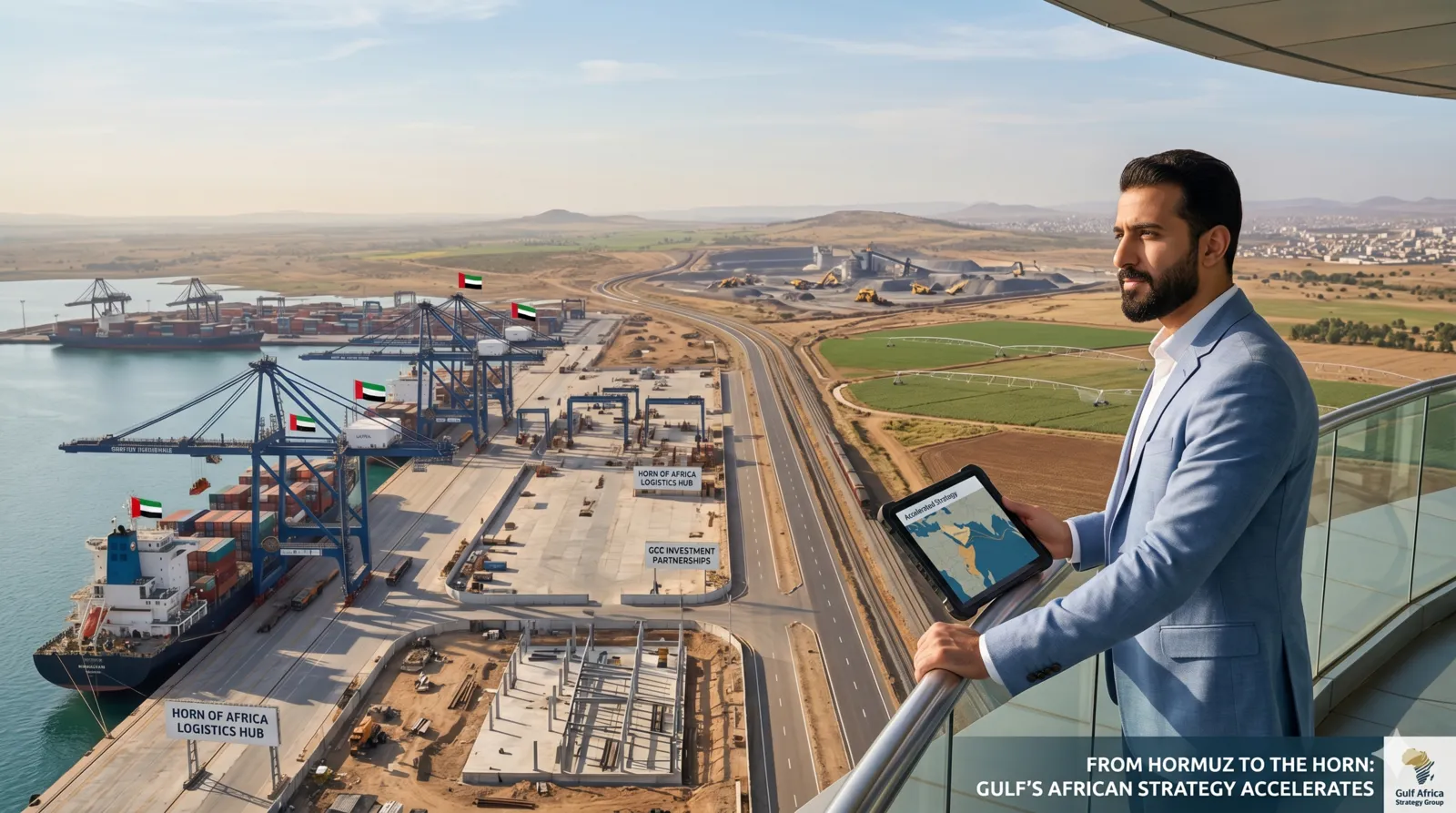
East Africa, running from Egypt through Sudan, Ethiopia, Eritrea, Djibouti, Somalia, Kenya, Tanzania, and Mozambique, hosts the most operationally significant concentration of Gulf-controlled port and logistics infrastructure. DP World operates the Berbera port concession (whose underlying sovereignty arrangements remain politically contested between Somaliland and the Federal Government of Somalia), terminal operations in Dar es Salaam, the Maputo concession, and a portfolio of smaller terminals and logistics assets. AD Ports has acquired or developed positions across the same coastline. The strategic logic of this concentration is direct: the African coastline that faces the Gulf is the maritime corridor on which the strategic significance of African geography to Gulf economic security most directly depends.
Central Africa, dominated by mineral assets in the Democratic Republic of the Congo, Zambia, and increasingly Guinea and Mauritania, has attracted the principal Gulf mining deployments. The Saudi and Emirati positions are concentrated against the specific input requirements of their respective industrial strategies (copper and cobalt for battery and EV supply chains, bauxite for aluminium, manganese for steel and battery applications, lithium for batteries, and gold across multiple use cases).
West Africa, particularly Senegal, Côte d'Ivoire, Nigeria, and Ghana, has attracted material Gulf interest in financial services, telecommunications, agricultural inputs, and the early commercial development of green hydrogen export projects that link African renewable resource endowment to Gulf industrial and capital capability.
The geographic emphasis of each Gulf state varies. Abu Dhabi's deployments are the most evenly spread across the continent. Riyadh's are concentrated in the mineral belt and in the religious-cultural diplomatic geography of the Sahel and Horn. Doha's are concentrated in North and East Africa and in financial services across the principal sub-Saharan economies.
African Agency
The framing of African states as passive recipients of foreign capital is both analytically wrong and politically obsolete. The African political economy of 2026 is materially different from that of even a decade ago, and the strategic posture of the principal African states toward Gulf capital is more sophisticated than much of the international analysis acknowledges.
Several African sovereign wealth funds and parastatal investment vehicles are themselves active counterparties in the deployment of capital across the continent. The Nigerian Sovereign Investment Authority, the Senegalese FONSIS, Rwanda's Agaciro Development Fund, the Botswana Pula Fund, and the Egyptian Sovereign Fund, alongside the major African pension funds and parastatal investment vehicles, all play roles in structuring Gulf-African transactions that go beyond the recipient role conventional analysis assumes. African private capital, particularly the family conglomerates of West and Southern Africa, the increasingly significant Mauritian and South African private equity industry, and the rapidly developing alternative asset management capability in Nigeria, Kenya, and Egypt, are themselves participants in many of the largest transactions, often as co-investors with Gulf principals.
The state negotiating capacity of the largest African economies has materially improved. The terms on which Egypt structured the Ras El Hekma transaction, on which Morocco has structured its renewable energy partnerships, on which Senegal has structured its hydrocarbon and increasingly green hydrogen agreements, and on which Kenya and Ethiopia have managed the Gulf maritime presence on their coastlines, reflect a level of institutional capability that the older framings of Africa-as-recipient do not capture.
What remains uneven is the distribution of this capability. The institutional capacity of Egypt, Morocco, Senegal, Kenya, Rwanda, and South Africa to negotiate, regulate, and where necessary renegotiate the terms of Gulf engagement is meaningfully stronger than that of the Sahelian states, the Horn states beyond Ethiopia and Kenya, and several of the Central African states whose mineral assets have attracted the largest Gulf deployments. The strategic question for the next decade is whether the institutional capacity gap between the high-capacity and lower-capacity African states will narrow or widen under the pressure of accelerating foreign capital deployment.
The African Union, the African Continental Free Trade Area institutional architecture, and the African Development Bank are each, at varying paces, attempting to build the regional capability to manage capital flows whose scale individual states cannot always manage alone. The success of these institutional efforts is one of the more consequential variables determining how the next phase of the Gulf-Africa relationship plays out.
The Tests the Strategy Has Yet to Pass
Three tests will define whether the acceleration of Gulf-Africa engagement produces the strategic returns its architects intend or the structural disappointments that comparable capital deployments have produced for previous generations of external investors in Africa.
The first is the political and reputational test, of which Sudan is the most acute current expression but not the only one. The credibility of Gulf institutions as long-term strategic partners on the continent will be substantially determined by whether the political and reputational liabilities created by Gulf engagement in active African conflicts are managed in ways that the African political class, civil society, and successor governments find acceptable. It is a structural condition of the durability of the asset base.
The second is the governance and regulatory test. The Gulf institutions executing the African strategy have built impressive deal-making capability. The capability they have invested less in, and that the next phase will require materially more of, is the on-the-ground regulatory, political, environmental, social, and labour management capacity that African operating environments demand. The Western and Chinese institutions that have preceded the Gulf in Africa have learned, often expensively, that the cost of underinvesting in this capability is paid in operational disruption, contract revision, regulatory reversal, and eventually political renegotiation. The Gulf institutions are at the early stage of this learning curve.
The third is the currency and macroeconomic test. The capital being deployed is dollar- or dirham-denominated; the cash flows being acquired are denominated in African local currencies whose long-term stability is, in several of the most important deployment geographies, conditional on macroeconomic and political variables outside the investor's control. The hedging capability available to manage this exposure is limited and expensive. The Gulf institutions have substantially absorbed this risk so far because the strategic logic of the deployment justifies it. Whether they continue to do so under conditions of significant currency disruption, or whether the response is the partial divestment that previous external investors have eventually pursued, is a test the next decade will impose.
What Ethos Chain Sees
For corporate boards, financial institutions, and governments considering exposure to this transformation, the most useful frame sits between the celebratory one favoured by promotional Gulf coverage and the dismissive one favoured by competitive Western coverage. The Gulf-Africa pivot is a serious, sustained, well-resourced strategic project. It is also one whose long-term success will be conditional on political, governance, and reputational capabilities the executing institutions have not yet fully demonstrated.
The Gulf-Africa relationship is the largest live test in the global economy of whether sovereign capital deployed at scale into politically complex environments can produce the strategic durability its architects intend. The institutions that read the test accurately will be the ones whose African positions endure. The ones that mistake the deal-making phase for the strategy will discover, as previous external investors have, that the value of African positions is conditional on capabilities capital alone does not buy.
For more information on how Ethos Chain can support your organisation's
strategic positioning across the Gulf and Africa, including political risk assessment and counterparty diligence on Gulf-African transactions, please get in touch.