When the UAE announced the dismantling of an alleged 27-member cell linked to Iran's Wilayat al-Faqih in April 2026, the world saw a security operation. Ethos Chain sees something more consequential: the exposure of an ideological architecture that is fracturing from within, and the systemic risks that fracture creates for every government, institution, and enterprise operating across the Gulf and wider MENA region.
The Arrest That Revealed an Architecture
On 20 April 2026, the UAE State Security Department announced the dismantling of a covert network allegedly linked to Iran's Wilayat al-Faqih, the "Guardianship of the Islamic Jurist." Twenty-seven suspects were arrested, their names and mugshots published. The charges, as described by UAE authorities, included establishing a secret organisation on UAE soil, pledging allegiance to a foreign governing authority, conducting covert recruitment and indoctrination operations, and transferring funds to what the State Security Department described as "suspicious foreign entities." The suspects are yet to face trial.
The operation was significant in its own right. But its deeper significance lies in what it reveals about the ideological infrastructure through which Iran has projected influence across the region for more than four decades, and what happens to that infrastructure when its central organising principle is contested, its guardian is incapacitated, and its command structures are fragmenting.
To understand why this matters for the Gulf today, it is necessary to understand the doctrine itself.
A Revolution in Shia Political Theology
Wilayat al-Faqih is a theological claim before it is a political arrangement, the assertion that in the absence of the Twelfth Imam, a senior Islamic jurist possesses divine authority to govern the Muslim community. To govern outright, with supreme political, military, and judicial power above all elected institutions.
This was Ayatollah Ruhollah Khomeini's radical innovation during the 1979 Islamic Revolution, and it represented a profound departure from centuries of Shia political thought. The dominant tradition within Shia Islam, sometimes called the "quietist" school, held that clerics should counsel rulers and attend to matters of religious law, but that direct political governance should await the return of the Hidden Imam. Scholars advised. They did not command armies.
Khomeini rejected this entirely. He argued that passivity in the face of injustice was itself a form of complicity, and that a qualified jurist had the obligation, and the right, to exercise absolute authority. His interpretation was never universally accepted, even within the seminary city of Qom, Iran's own theological heartland. The RAND Corporation has noted that "despite three decades of Khomeinist rule in Iran, Qom today continues to be a source of quietism," though quietist scholars have tended to express their views privately, if at all.
From Najaf, the rival centre of Shia scholarship in Iraq, Grand Ayatollah Ali al-Sistani has maintained a consistent and influential counter-position. Sistani envisions a state guided by Islamic values but governed by elected civilians, not commanded by clerics. Researcher Hayder Khoei has documented how pro-Tehran propagandists have published books containing fabricated quotes attributed to Sistani in support of Wilayat al-Faqih, a measure of how threatening Najaf's opposition is to Tehran's legitimacy claims. Sistani, like the vast majority of Shia clerics based in Najaf, is well-known for his opposition to the doctrine.
This theological contest has simmered for decades. What has changed is that the doctrine's central pillar, the guardian himself, has been removed.
The Guardian Falls
On 28 February 2026, US and Israeli airstrikes killed Ayatollah Ali Khamenei, Iran's Supreme Leader since 1989. His death created a constitutional and theological crisis for which the Islamic Republic had no adequate precedent.
Under Iran's constitution, a three-person leadership council assumed interim authority: President Masoud Pezeshkian, judiciary chief Gholamhossein Mohseni Ejei, and senior cleric Alireza Arafi. On 9 March, the Assembly of Experts selected Mojtaba Khamenei, Ali Khamenei's son, as the new Supreme Leader.
The appointment was contested from the outset. Mojtaba lacked the broad clerical standing traditionally expected of a supreme leader. Several senior clerics publicly questioned his qualifications. Reformist factions had pushed for Hassan Khomeini, grandson of the revolution's founder, or former president Hassan Rouhani, figures with greater theological credibility and institutional support.
What followed was not a succession. It was a fracture.
The Supreme Leader Who Is Not Supreme
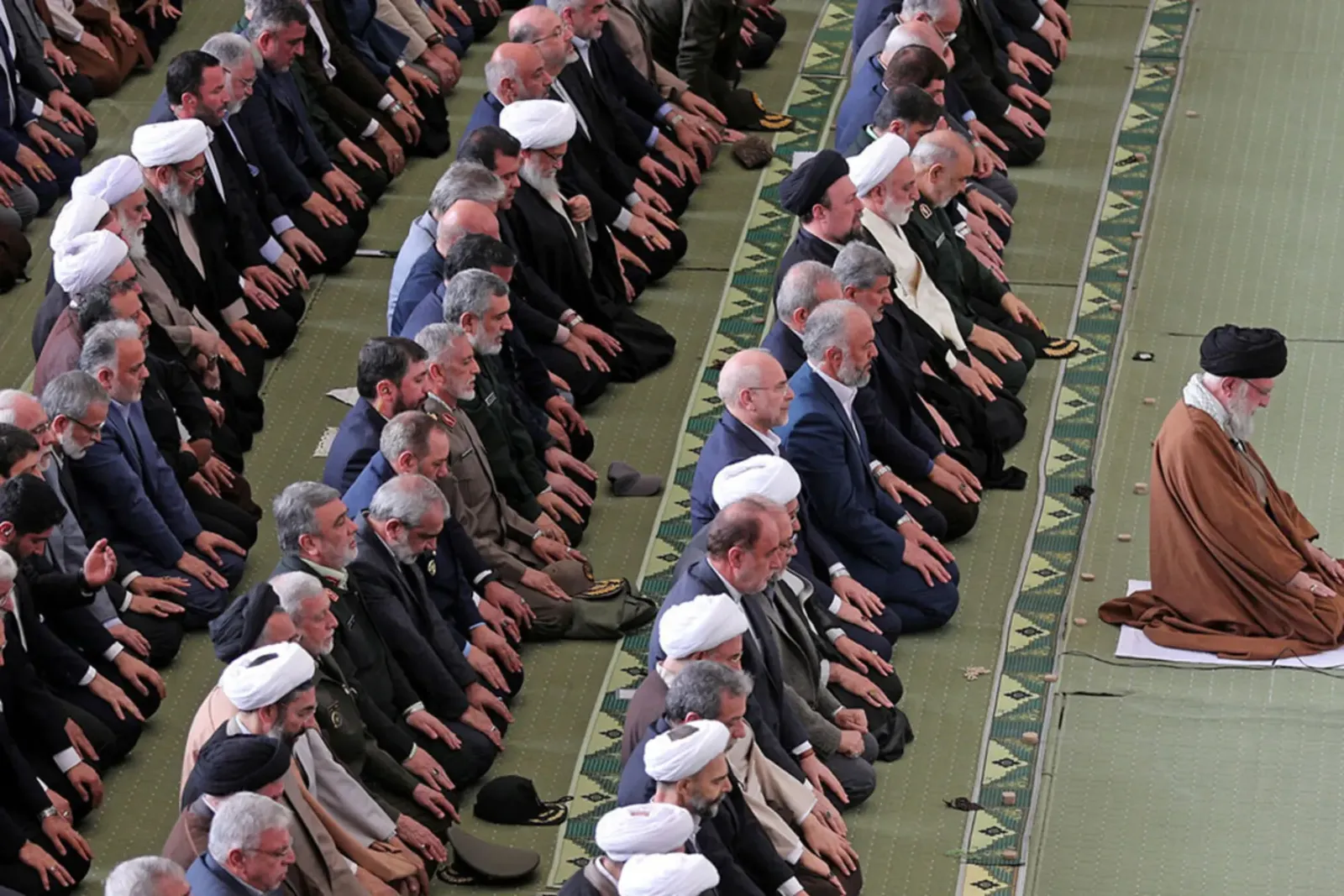
Since his appointment, Mojtaba Khamenei has made no public appearances. Officials have attributed his absence to security considerations and severe injuries reportedly sustained during airstrikes that targeted a leadership compound in the opening phase of the war. But reporting from multiple credible sources paints a more concerning picture: a leader who is physically constrained, communicating through couriers, and increasingly isolated from his own government.
A military council of senior IRGC officers now controls access to the centre of power, reportedly preventing government reports from reaching Mojtaba and effectively sidelining President Pezeshkian. US and Israeli intelligence assessments, as reported by the Jerusalem Post, conclude that Mojtaba is "not functioning as leader" and that IRGC commanders are making strategic decisions on his behalf.
This represents a structural transformation of the Islamic Republic. The Wilayat al-Faqih doctrine vests supreme authority in a single jurist whose legitimacy derives from religious scholarship and divine mandate. When that authority is exercised instead by military commanders with no theological standing, the doctrine is not being implemented. It is being hollowed out. The form persists; the substance has been replaced by something entirely different; a military junta operating behind a clerical facade.
Ethos Chain would observe that this is a textbook example of governance diffusion: the dispersal of decision-making authority across competing power centres in ways that make institutional behaviour unpredictable and accountability impossible to trace.
The IRGC: Power Without Doctrine
The Islamic Revolutionary Guard Corps has always existed in tension with the civilian institutions of the Islamic Republic. But that tension was historically mediated by the Supreme Leader, who served as the constitutional arbiter between the IRGC, the presidency, the judiciary, and the clerical establishment.
Without an effective arbiter, the IRGC's institutional weight becomes determinative. And that weight is substantial. Credible independent estimates place IRGC-affiliated entities and foundations, the bonyads, in control of roughly a third of Iran's GDP, with some analysts arguing the figure is considerably higher once indirect influence over procurement, licensing, and import monopolies is included. In the 2025-2026 budget, Iran reportedly allocated over half of all oil and gas export revenues to the IRGC and the broader security and defence apparatus. The Khatam al-Anbiya engineering conglomerate alone controls refineries, railways, dams, pipelines, and Tehran's international airport.
The IRGC is an economic empire, a political faction, and an intelligence apparatus as well as a military force. What it lacks is religious legitimacy, and in a system whose entire constitutional architecture rests on the divine authority of a supreme jurist, that absence matters.
The question confronting Iran is whether Wilayat al-Faqih can survive as a governing principle when the institution exercising actual power has no doctrinal authority to do so. Ethos Chain's assessment is that it cannot, at least not in its current form. What is emerging is a hybrid structure in which theological language provides cover for military governance, and in which the coherence of strategic direction that characterised Iran under Khamenei is replaced by factional competition within the security apparatus.
The Proxy Network Splinters
The implications extend far beyond Iran's borders. For more than forty years, Wilayat al-Faqih served as the ideological adhesive binding Iran's regional proxy network. Hezbollah, the Houthi movement, Iraqi Popular Mobilisation Forces, and cells like the one allegedly dismantled in the UAE received more than weapons and funding from Tehran. They operated within a shared ideological framework that conferred purpose, legitimacy, and, critically, strategic coherence.
That coherence is now fragmenting. Three distinct patterns have emerged since the war began.
Hezbollah, long considered the crown jewel of Iran's proxy architecture, is fighting an Israeli ground invasion in southern Lebanon with a leadership cadre decimated by successive assassinations. Its operational capacity is degraded, and its ability to receive strategic direction from a Tehran that is itself in disarray is severely compromised.
The Houthis in Yemen have taken a markedly independent path. Despite ideological solidarity with Tehran, they have declined to escalate militarily during the 2026 war, prioritising their ongoing peace process with Saudi Arabia and consolidation of governance over northern Yemen. With an estimated $1.8 billion in annual revenue from port and customs control, according to UN Panel of Experts assessments, the Houthis are the most operationally self-sufficient of Iran's partners, and increasingly characterised by analysts as willing allies rather than directed proxies.
Iraqi PMF factions present a third dynamic. With direct overland access to Iran, unlike Hezbollah or the Houthis, who depend on disrupted maritime and air corridors, the Iraqi militias have gained relative power within the network. That increased leverage has emboldened their leadership to demand greater independence from Tehran, even as the US conducts approximately 100 airstrikes against PMF positions. The Iraqi government, whose military formally incorporates these same militias, faces an impossible sovereignty dilemma.
The common thread is one Ethos Chain sees across networked organisations of every kind: when the ideological centre of a networked organisation is contested, the nodes do not collapse in unison. They pursue local logic. They make independent calculations. They become less predictable, not less dangerous.
What This Means for the Gulf
For governments, institutions, and enterprises operating across the GCC and wider MENA region, the fracturing of Wilayat al-Faqih creates a specific and underappreciated category of risk.
The conventional threat model for Iran-linked activity assumed a degree of strategic rationality, that proxy actions served identifiable Iranian objectives and could therefore be anticipated within a framework of state-level analysis. A cell operating under the doctrinal authority of the Supreme Leader could be understood, however imperfectly, as an extension of Iranian state policy.
That assumption no longer holds with the same confidence. When the UAE arrested 27 alleged operatives pledging allegiance to Wilayat al-Faqih, it arrested individuals whose nominal chain of command leads to an incapacitated leader, isolated by military handlers, whose authority is contested by senior clerics in both Qom and Najaf. It is possible the cell was operating on directives established long before the current crisis; covert networks often function on pre-set mandates. But it is equally possible that the cell's operational logic has drifted from whatever strategic intent originally guided it. Either way, the question of who is directing such networks today, and to what coherent end, no longer has a straightforward answer. That ambiguity is itself the risk.
For the Gulf states that host US military assets, Kuwait, Bahrain, Qatar, and the UAE, the fragmentation of Iranian command structures means that escalatory decisions may be made by local commanders or proxy leaders without reference to a coherent national strategy. The IRGC strikes on US military facilities in Jordan, Kuwait, and Bahrain, the seizure of container ships in the Strait of Hormuz, and the continued drone and missile attacks on Saudi energy infrastructure all carry the signature of operational autonomy rather than coherent strategic direction.
For the corporate and institutional actors operating in this environment, energy companies, financial institutions, logistics operators, sovereign wealth funds, the implication is that country-level risk assessments are no longer sufficient. The relevant unit of analysis is the network rather than the state, and that network is behaving in ways that its own architect did not design.
What Ethos Chain Sees
The dismantling of the UAE cell is a data point in a much larger pattern. The Wilayat al-Faqih doctrine, the single most consequential political innovation in modern Shia Islam, is being tested to destruction by the internal contradictions that its founder suppressed and that his successors can no longer contain.
Khomeini built a system that required an extraordinary individual at its apex: a scholar with the theological credibility to command obedience, the political acumen to balance competing factions, and the strategic discipline to direct a regional network spanning four countries. Khamenei, whatever his limitations, sustained that balance for nearly 37 years. What has replaced him is a vacuum, filled by military officers with guns and economic leverage, contested by clerics with competing visions, and exploited by proxy organisations pursuing their own survival.
The most dangerous risks are structural. A missile strike is a situation. The collapse of the ideological architecture that gave strategic coherence to an entire regional threat network is a structural transformation, one that will shape the security, economic, and governance conditions of the Gulf for years to come.
The contest between Qom and Najaf, between those who believe a jurist must govern and those who believe he must not, has left the seminary halls and is playing out in real time, under conditions of war, with consequences for every state and institution in the region.
The question now is what replaces the doctrine of the guardian, and whether the governments and organisations operating in its shadow are prepared for what comes next.
For more information on how Ethos Chain can support your organisation's
management of geopolitical risk and Iran-related exposure across the Gulf and wider MENA region, please get in touch.