
Financial Warfare and Corporate Exposure
Understanding sanctions regimes and economic statecraft implications for multinational operations.
Read Article →
March 2026 • 12 min read
By Spencer John, Chief Executive Officer
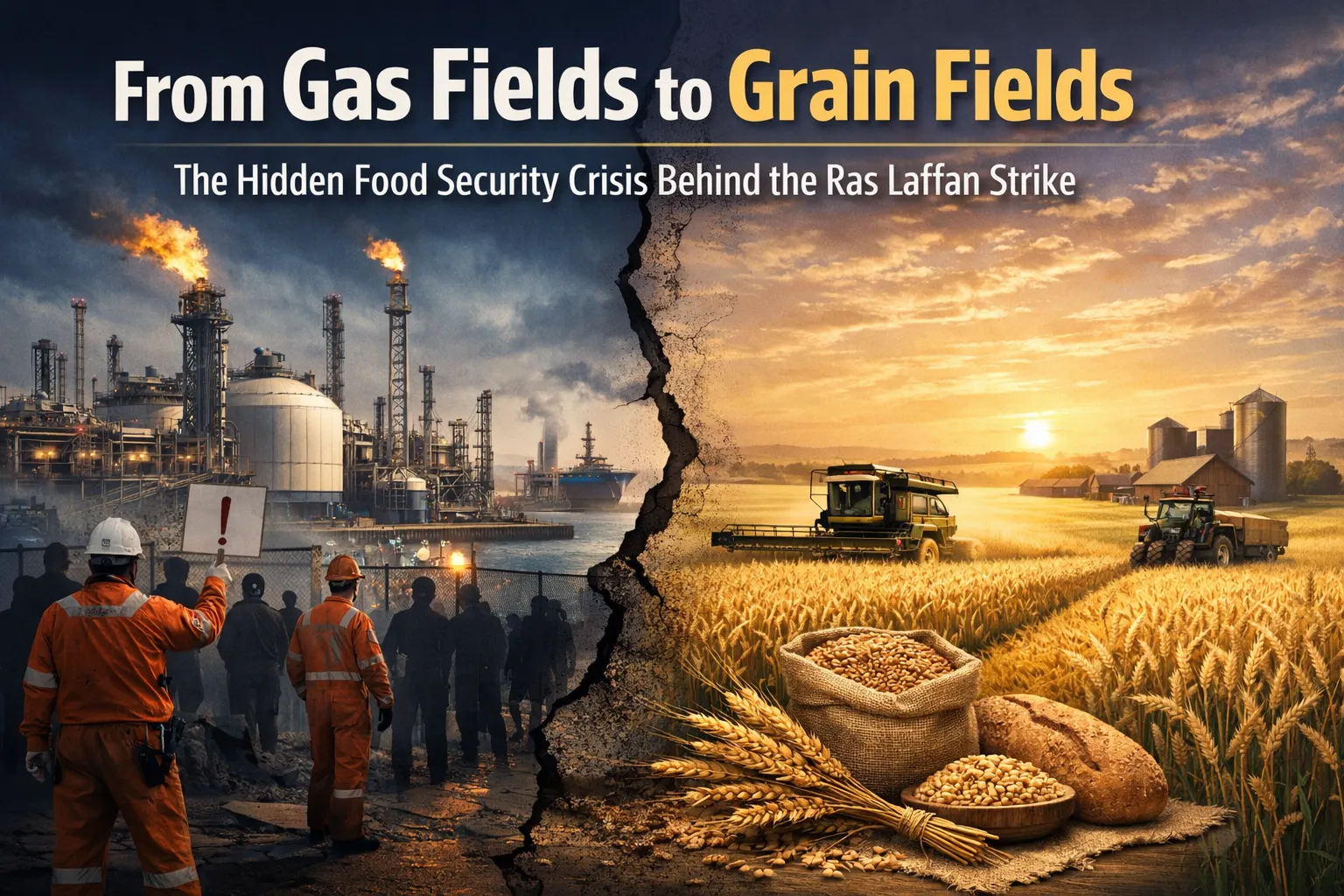
In the second of a series examining the non-obvious consequences of the Iranian strike on Qatar's Ras Laffan Industrial City, Ethos Chain turns its attention from helium and semiconductors to something far more fundamental: the food on your plate.
When Iranian missiles struck Ras Laffan Industrial City on 18 March 2026, the world's media rightly focused on the energy implications. Qatar, the world's second-largest LNG exporter, saw 17% of its export capacity destroyed in a single salvo. Oil prices briefly touched $119 a barrel. QatarEnergy declared force majeure. The headlines wrote themselves.
Yet Ethos Chain believes the most consequential impact of the Ras Laffan strike is not being discussed in energy columns or defence briefings. It is unfolding quietly in the fertiliser markets, and from there it will reach into the food supply chains of every nation on earth.
This is precisely the kind of second-order, systemic risk that conventional analysis fails to capture. It requires the ability to trace a missile impact in the Persian Gulf through industrial chemistry, across oceanic shipping lanes, into the soil of farms in Iowa, Maharashtra, and Mato Grosso, and ultimately onto the plates of billions of people.
Most observers know Qatar for its gas and its sovereign wealth. Far fewer appreciate that Ras Laffan is home to the Qatar Fertiliser Company (QAFCO), the world's largest single-site urea exporter, commanding approximately 14% of global supply with an annual capacity of 5.6 million metric tonnes.
Urea is not a niche industrial product. It is the world's most widely used solid nitrogen fertiliser, and nitrogen is the single most critical input for the staple crops that feed humanity: corn, wheat, and rice. Without adequate nitrogen application, yields collapse. The arithmetic is unforgiving: agronomists estimate that a reduction of just 10% in nitrogen and phosphate application could reduce global corn and wheat yields by 5% to 8%.
The strike on Ras Laffan damaged more than gas infrastructure. It struck at the heart of a system that converts natural gas into the chemical building blocks of global food production.
The damage to Ras Laffan alone would constitute a serious disruption. But Ethos Chain's analysis identifies a compounding factor that dramatically amplifies the crisis: the near-total closure of the Strait of Hormuz.
Since 28 February 2026, maritime traffic through the Strait has collapsed by approximately 97%. This reaches far beyond Qatar. The Persian Gulf is the undisputed centre of the global nitrogen and phosphate trade, accounting for 43% of all seaborne urea exports and 44% of global seaborne sulfur supply.
Sulfur is a critical and often overlooked input. It is the precursor to sulfuric acid, which is essential for producing the phosphoric acid used in DAP and MAP fertilisers. China imports roughly four million metric tonnes of sulfur annually from the Gulf. Morocco's OCP Group, the world's largest phosphate exporter, depends on approximately 3.7 million metric tonnes. When sulfur stops flowing, phosphate production seizes in the processing facilities of entirely different continents.
Ethos Chain would observe that this represents a textbook example of how systemic risk propagates through hidden dependencies. The Ras Laffan strike and the Hormuz blockade have not disrupted one supply chain. They have simultaneously severed the two primary chemical pathways, nitrogen and phosphorus, through which the world feeds itself.
The markets have not waited for the analysis. Urea prices have surged more than 30% since the conflict began, reaching a benchmark of $550 per tonne at the Port of New Orleans, with global spot prices reported as high as $680 per metric tonne. This represents a move from a pre-war baseline of approximately $470 per tonne, a spike that is accelerating as inventories deplete and no resolution to the Hormuz closure appears imminent.
For commodity traders, this is a price signal. For the populations of developing nations, where food expenditure can represent up to 50% of average household spending, it is the early tremor of a humanitarian crisis.
What makes this crisis particularly acute is its timing. The Northern Hemisphere spring planting window is open now. Farmers across the United States, Europe, India, and China are making fertiliser application decisions that will determine yields for the remainder of 2026 and into early 2027.
These decisions are irreversible. A farmer who cannot source urea in March cannot retrospectively apply it in July. The biological clock of crop growth does not accommodate geopolitical disruption.
In the United States, which relies on the Gulf for approximately 17% of its urea and 20% of its phosphate consumption, the agricultural community is watching what industry analysts have termed the "mid-April hard deadline" for nitrogen application with growing alarm. If supply does not materialise, American farmers face a stark choice: plant with inadequate fertilisation and accept lower yields, or reduce acreage entirely.
Ethos Chain's assessment is that the most severe consequences will fall on nations least equipped to absorb them.
India relies on the Gulf for nearly half of its urea supply. Fertiliser firms in India, Bangladesh, and Pakistan have already been forced to suspend production as feedstock supplies have been cut. For a nation of 1.4 billion people where agriculture employs approximately 42% of the workforce, this is not an economic inconvenience. It is a food security emergency.
Brazil, the world's largest soybean exporter, imports over 80% of its fertilisers, with more than 40% of its urea supply typically transiting the Strait of Hormuz. Brazil's agricultural sector, the engine of its economy and a critical node in global food supply, is now operating on rapidly depleting inventories.
Across Sub-Saharan Africa and South Asia, where smallholder farmers operate on thin margins and limited reserves, the cascading effect of fertiliser scarcity will be felt most acutely and with the least capacity for mitigation.
Ethos Chain would suggest that the international community has approximately eight to twelve weeks before the fertiliser shortage translates into irreversible planting decisions that will constrain food production through the end of 2027. The inflationary tail of this crisis (rising food prices, social instability, and increased pressure on already strained government budgets) could persist for eighteen months or more.
There is a further dimension that has received almost no attention. Ras Laffan Industrial City produces more than LNG and fertiliser. It hosts desalination facilities that provide approximately 20% of Qatar's potable water supply.
Qatar, a desert nation with negligible natural freshwater resources, now faces the prospect of losing a fifth of its drinking water capacity as a direct consequence of an attack on what the world perceives as an energy facility. The attacker has created a potential humanitarian crisis in a country it was not directly targeting, a reminder that in interconnected industrial complexes, the blast radius of a strike extends far beyond its physical impact zone.
Ethos Chain's analysis of the Ras Laffan strike and the broader Gulf crisis identifies a pattern that the firm encounters repeatedly in its advisory work: the most dangerous risks are those that cross sector boundaries.
Defence analysts see a military strike. Energy analysts see an LNG disruption. What neither discipline typically captures is the chain of consequences that runs from a gas processing facility in Qatar, through the global fertiliser trade, into the soil chemistry of farms on four continents, and ultimately into the food prices that determine social stability in the world's most vulnerable nations.
This is what Ethos Chain means by systemic risk: the power of an event to propagate through systems that appear unrelated until the moment they fail simultaneously.
The Ras Laffan strike has exposed a truth that Ethos Chain believes organisations and governments must urgently confront: critical dependencies sit where nobody is looking. The world's food security depends, alongside farms, weather patterns, and agricultural policy, on a gas processing facility in the Persian Gulf, a narrow strait, and a set of chemical processes that most policymakers have never considered.
The question now is whether the world's governments and institutions will recognise what is unfolding before the planting window closes, or whether they will discover the connection between Ras Laffan and their food supply only when it arrives on the supermarket shelf.
For more information on how Ethos Chain can support your organisation's geopolitical risk assessment and supply chain vulnerability analysis, please get in touch.
Understanding sanctions regimes and economic statecraft implications for multinational operations.
Read Article →
How advanced analytics and intelligence are transforming supply chain verification.
Read Article →
The strategic implications of concentrated mineral supply chains.
Read Article →