
Critical Minerals and the New Resource Geopolitics
The strategic implications of concentrated mineral supply chains and emerging responses from governments and corporations. Security of supply in the energy transition.
Read Article →
May 2026 • 12 min read
By Spencer John, Chief Executive Officer
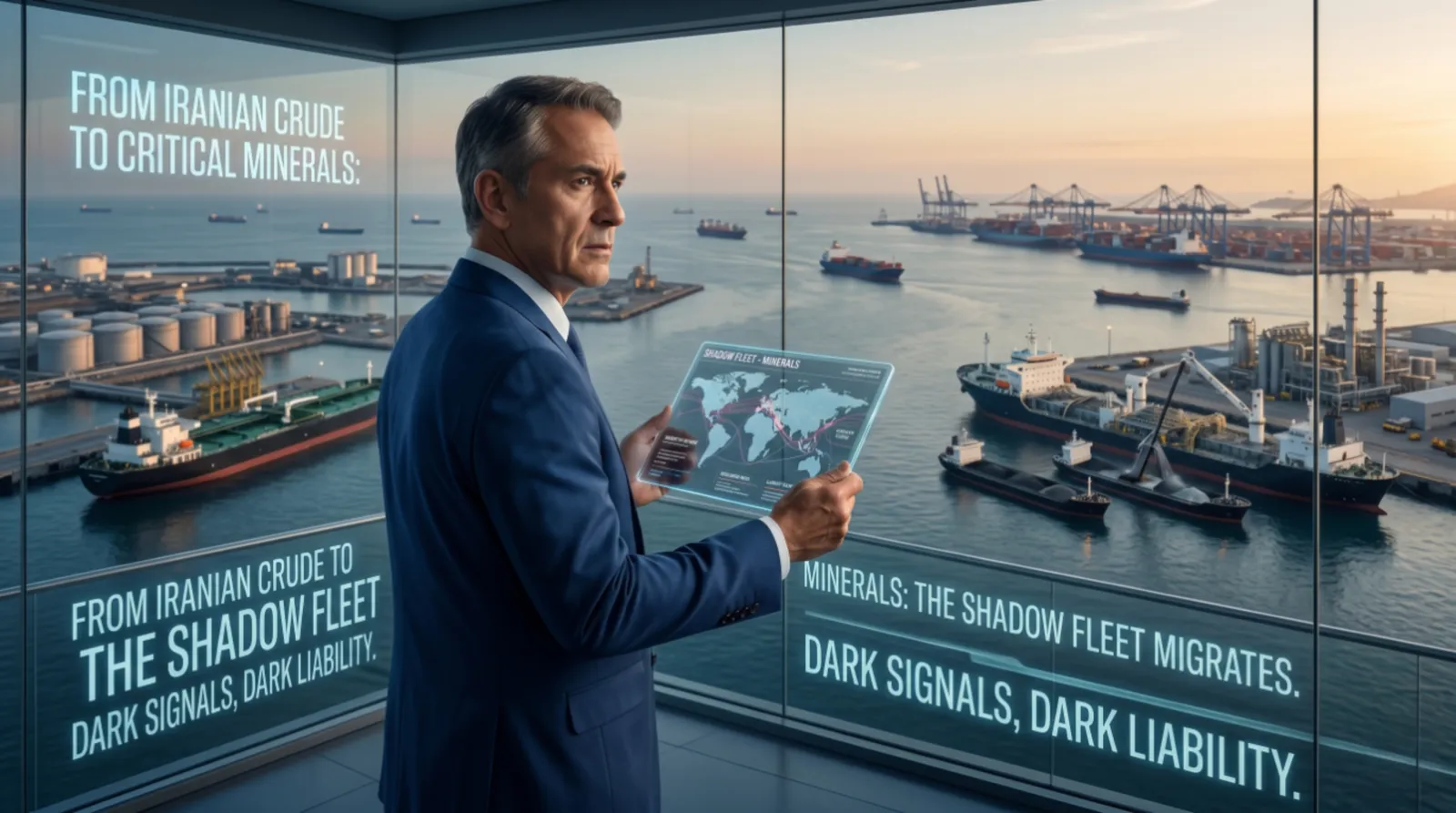
The playbook that emerged from sanctioned oil flows after 2022 has matured into something broader: a portable, jurisdiction-agnostic system for moving sanctioned and grey-market goods through the gaps in the world's verification infrastructure. The most consequential exposure it now creates sits in the critical minerals supply chains on which the industrial strategies of half the world's largest economies depend, well beyond the energy trade where it began. Ethos Chain's assessment is that this exposure is materially under-recognised on the balance sheets of the companies most central to the energy transition and to the industrial strategy of the next decade.
The shadow-fleet phenomenon that dominates the maritime press is best understood as a Russian architectural achievement. After the G7 oil price cap took effect in late 2022, a state with substantially greater technical and financial capacity than Iran industrialised the techniques of AIS manipulation, ship-to-ship transfer, flag-of-convenience layering, and corporate obfuscation into a system that has since moved several million barrels a day of sanctioned crude with very limited interdiction. Iran's own shadow fleet, which long pre-dates the 2022 model, has scaled rapidly by adopting and adapting it. Venezuela's smaller fleet has followed. The operational template is now generic.
The most credible public estimates come from United Against Nuclear Iran's Ghost Armada tracker for the Iran-specific component, and from Kpler, Vortexa, and Lloyd's List Intelligence for Russian and Venezuelan flows. UANI's Ghost Armada now identifies in excess of 570 vessels engaged in Iranian oil movement, up from under 100 at its launch in late 2020 and continuing to grow even as wartime US naval enforcement has, in May 2026 specifically, collapsed Iran's actual export volumes to approximately 65,000 barrels per day from a pre-war level of roughly 1.5 million. The combined Russian, Iranian, and Venezuelan shadow fleet is most credibly estimated at between 1,200 and 1,500 vessels in total, with Russian flows continuing at scale through the war period and Venezuelan flows smaller but operationally similar. The gap between the size of the identified fleet and the volume of Iranian oil actually moving in May 2026 is itself analytically significant: the architectural infrastructure of sanctions evasion persists even when individual export flows are interdicted, and the latent capacity returns when enforcement pressure relaxes.
Designations have accelerated through the war period. OFAC added sixteen Ghost Armada vessels to the SDN list in May 2026 alone, with parallel actions from the UK Office of Financial Sanctions Implementation. The pre-war pattern of designations lagging the rate of new vessels entering the fleet has been temporarily reversed by wartime enforcement intensity, though the broader architectural capacity, particularly the Russian component, has continued to expand.
Ethos Chain's interest, however, is not in cataloguing a maritime problem that specialist outlets already document well. It is in identifying where the playbook is going next, and where the next major loss event is most likely to originate.
The system rests on four operational primitives, each well documented in OFAC's published action sheets and in the secondary literature produced by RUSI, the Atlantic Council, the FATF, and the major commercial maritime intelligence providers. They are worth restating briefly because their migration into non-maritime trade is the substantive concern of this analysis.
The first primitive is identity obfuscation in transit. In maritime trade this is AIS manipulation, spoofing, or "going dark" through transponder disablement. In overland trade the analogue is documented routing through transhipment hubs that issue origin certificates without underlying provenance verification. In commodity trade more generally the analogue is the conversion or re-labelling of material through a refining, smelting, or processing step that legally re-bases the origin of the product. The maritime version is the most visible. The overland and processing versions are operationally older.
The second primitive is ownership layering. Single-purpose vehicles in non-disclosing jurisdictions, nominee directors, and management contracts that separate beneficial control from registered ownership. The same architecture is used to hold tankers as to hold mineral processing facilities, gold refining capacity, and the trading entities that intermediate between them.
The third primitive is the flag, the certification, or the documentation provider whose business model rewards transaction volume rather than verification rigour. In maritime trade these are the smaller flag registries and a handful of classification societies. In minerals trade these are mineral origin certification schemes whose audit cycles can be measured in years. In gold trade these are refiners whose due diligence has been the subject of repeated investigative reporting. In each domain the structural function is identical: an entity provides a paper guarantee whose value depends on its reputation, and whose reputation depends on the absence of enforcement events sufficient to alter that reputation.
The fourth primitive is the absorption of risk by intermediaries operating in jurisdictions whose appetite for enforcement against locally-resident facilitators is limited. This is the most politically delicate dimension of the phenomenon. It is also where the most material change in the corporate exposure landscape has occurred since 2024.
A Dubai-headquartered advisory firm has a particular obligation to address the part of this picture that involves the UAE directly, and Ethos Chain has no interest in writing analysis that omits it.
The Fujairah anchorage, immediately outside the Strait of Hormuz, is the world's largest ship-to-ship transfer zone for crude and refined products. A substantial fraction of public OFAC designations relating to Iranian, and increasingly Russian, oil movements name vessels that conducted STS operations in Fujairah waters, ship management companies registered in Dubai's free zones, bunker suppliers and chandlers operating from UAE ports, and trading houses registered in the Dubai Multi Commodities Centre. The pattern is sufficiently consistent that the US Treasury, the European Commission's DG FISMA, and the FATF have each, in different formulations, identified the UAE as a high-priority jurisdiction for sanctions-evasion-enabling activity.
The UAE federal government has responded with material reforms: the establishment of the Executive Office for Anti-Money Laundering and Counter-Terrorism Financing, expanded ultimate beneficial ownership disclosure requirements, the registration regime for designated non-financial businesses and professions, and an enforcement record that, while uneven, has produced significant fines and designations against locally-resident facilitators. The UAE was removed from the FATF grey list in early 2024 following a multi-year reform programme. The trajectory is real.
The trajectory has not, however, eliminated the underlying exposure. The federal regime sits above seven emirate-level authorities and several dozen free-zone regulators whose enforcement capacities and political incentives are not uniform. The volume of trade routed through UAE jurisdictions is large enough that the absolute number of high-risk transactions remains material even where the percentage has fallen. And the geopolitical position of the UAE, as a hub equidistant between the principal sanctioned states and the principal sanctioning states, makes the country structurally central to any system that needs to move goods across that divide.
For corporate boards considering UAE counterparty exposure, the practical implication is not to disengage. The country is too important a node in global trade for serious institutions to avoid. The implication is to recognise that the residual risk inside UAE-routed transactions is structural, that the standard of diligence required is materially higher than the documentation a UAE-registered counterparty will typically provide unprompted, and that the assumption of regulatory protection sufficient to substitute for proprietary verification is no longer reliable.
This is awkward to write from a Dubai office. It is more awkward to leave unwritten.
The end-demand side of the shadow oil trade is concentrated in China, which continues to take well over a million barrels per day of sanctioned Russian crude alongside Iranian volumes that, before the May 2026 US naval blockade collapsed them, were running at approximately 1.5 million barrels per day. The Iranian component is now drastically reduced in volume terms, though the architectural infrastructure that moved it remains intact. The Russian component continues at scale. India takes meaningful but smaller volumes through intermediated structures. Türkiye, Syria, Pakistan, and a handful of smaller Asian and African refining markets account for the residual.
It matters how this end-demand is described. The Chinese teapot refining sector is not a rogue actor operating in defiance of Beijing's policy. It is a tolerated and, in the assessment of most Chinese-policy analysts, structurally relied-upon component of the People's Republic's strategic energy hedge, particularly under conditions in which Saudi-led OPEC supply discipline tightens conventional crude markets. The implication for the global compliance picture is significant. The shadow fleet is not facing a coordinated suppression effort across the world's three largest oil-consuming economies. It faces enforcement pressure from one bloc (the G7 and the EU), structural tolerance from a second (China), and inconsistent posture from a third (India). The architectural resilience of the system reflects this asymmetry.
The second-order effect, and the one that matters for corporate exposure outside the energy trade, is that a sanctions enforcement environment that cannot suppress the dominant Russian and Iranian flows is also unlikely to suppress the smaller, more diffuse, and operationally similar flows that are now establishing themselves in non-energy commodities.
The most consequential propagation of the shadow-trade architecture is now occurring in critical minerals. The corporate liability sitting downstream of those flows is materially under-recognised on the balance sheets of automotive manufacturers, battery producers, electronics firms, and defence contractors, the industrial base on which Western and East Asian economic strategy now depends.
The clearest case is gold. The artisanal and small-scale mining sector, principally in Sudan, the Sahel states (Mali, Burkina Faso, Niger), the eastern Democratic Republic of the Congo, and parts of Venezuela, accounts for a substantial fraction of the world's annual artisanal gold output of roughly 600 tonnes. On the public reporting of Swissaid's 2024 Sudan gold investigations, the OECD's Due Diligence Guidance unit, Global Witness, the UN Panel of Experts on Sudan, and successive investigative consortia, much of that material enters the legal refining circuit through documentation that substantially obscures origin. The dominant entry points are refiners in the UAE, Türkiye, and Switzerland whose due diligence practices have been the subject of repeated public criticism and intermittent regulatory action. From there the gold enters jewellery, central-bank reserves, and electronic component supply chains through documentation that meets the procedural threshold required by downstream buyers.
The cobalt and copper supply chain out of the eastern DRC carries an analogous but distinct exposure. Artisanal cobalt, frequently mined in conditions documented by Amnesty International, RAID, and the OECD, enters the legitimate trade through a small number of consolidators and is comingled with industrial-mine output before export, principally to Chinese refining capacity that then supplies the global battery industry. The provenance documentation that downstream automotive and electronics buyers receive describes the material's origin in terms whose legal sufficiency depends on a chain of attestations the buyer cannot independently verify.
The Russian palladium and nickel trade, the Venezuelan iron ore and gold trade, the Myanmar rare earths and tin trade, and the increasingly significant grey-market trade in critical minerals out of Afghanistan each replicate components of the same architecture. None is a perfect operational copy of the maritime shadow fleet. Each adopts a recognisable subset of its primitives.
The corporate exposure this creates is not theoretical. The European Union's Critical Raw Materials Act, the US Inflation Reduction Act sourcing requirements, the UK Modern Slavery Act, the German Supply Chain Due Diligence Act, the French Duty of Vigilance Law, and a parallel regulatory direction in Japan, Korea, and Canada have each, in different formulations, raised the standard of care expected of corporates whose supply chains touch high-risk jurisdictions. The trajectory is consistent: the legal exposure of a buyer who accepts documentation that subsequently proves to be fabricated is rising, while the visibility that buyers have into the actual provenance of their inputs is, in many supply chains, falling.
The shadow fleet sits in the OFAC and OFSI quarterly action sheets. The shadow minerals trade sits, today, in the supply chains of the companies most central to the energy transition and the industrial strategies of the world's largest economies. The visibility asymmetry is the strategic exposure.
The compliance functions of major corporates have invested heavily, particularly since 2022, in the technical infrastructure required to detect the visible end of the problem. Sanctions screening engines, beneficial ownership databases, AIS-based and increasingly satellite-radar-based maritime intelligence, transaction monitoring systems, and the network of specialist consultancies that audit these systems have produced a generation of compliance capability materially stronger than that of a decade ago. The chief compliance officers and general counsels of the relevant institutions are, in Ethos Chain's experience, neither uninformed nor under-resourced. They are operating inside a structural problem that no amount of procedural investment will fully address.
The structural problem is that the system they are screening for is now generative. New vehicles, new routes, new flags, new processors, and new documentation patterns enter the trade faster than the public designation cycle can respond to them. The detection infrastructure is, by construction, retrospective. It identifies what is already known. The shadow trade now operates at a pace at which what is known is a diminishing fraction of what is moving.
The implication is not that compliance is futile. It is that compliance, in the procedural sense in which it has historically been organised, is no longer sufficient. The institutions whose risk posture is best aligned with the current environment are those that have invested in three additional capabilities.
The first is intelligence-grade provenance verification. Satellite imagery, non-AIS vessel tracking, beneficial ownership investigation, and counterparty due diligence conducted at a depth and frequency that meaningfully exceeds the documentation a counterparty will produce unprompted. The vendor ecosystem, Windward, Pole Star, Kpler, Sayari, Refinitiv, OpenSanctions, and a number of smaller specialists, is mature. The question is procurement and integration, not availability.
The second is portfolio-level exposure mapping. Most large corporates can answer the question "is this counterparty on a list." Fewer can answer the question "what proportion of our input supply originates in jurisdictions where the shadow trade architecture is operationally active, and what is our concentration risk if a major enforcement event removes a tier-three supplier whose provenance we cannot independently verify." That second question is what determines whether the next OFAC quarterly action sheet produces a manageable disclosure or a material financial event.
The third is governance integration. Sanctions, supply chain, geopolitical, and reputational risk are still managed in many institutions as adjacent but separately-organised functions reporting through different committee structures. The shadow trade phenomenon does not respect those boundaries, and the exposures it creates cut across all of them. The institutions best positioned to respond are those that have integrated these functions, substantively, through unified analytical capability and unified reporting to the board, rather than procedurally through cross-committee membership.
The shadow trade phenomenon is the kind of structural transformation in which Ethos Chain's practice is grounded. The firm advises corporate boards, financial institutions, and sovereign clients on the design of provenance verification, counterparty intelligence, and integrated governance capability for exposures of exactly this kind. The work is unglamorous and largely invisible: most of it consists of asking institutions questions about their supply chains and counterparty networks that their existing functions are not configured to answer, and helping to build the analytical capability that produces the answers.
Three propositions follow from the analysis above, and they are propositions on which the firm's advisory work routinely depends.
First, the most material sanctions and supply-chain exposures in 2026 sit in the supply chains of companies whose ESG, sustainability, and procurement teams are confident in the documentation they receive from upstream counterparties they have never physically verified.
Second, the trajectory of regulatory enforcement is from intent to recklessness and from recklessness toward strict liability, particularly in the US, UK, and EU. A defence based on documentation subsequently shown to be fabricated, or on the absence of red flags subsequently shown to have been visible to a reasonably diligent counterparty, is becoming less reliable. That is a description of where the practical standard of care is heading rather than of strict liability as a legal doctrine.
Third, the institutions that will fare best in this environment are those that treat provenance and counterparty intelligence as a strategic capability rather than a compliance overhead. This means board-level visibility, integrated cross-function ownership, and the procurement of intelligence-grade tooling appropriate to the scale of the exposure. Adding procedural rigour to functions that have already invested heavily in it achieves little.
The shadow trade is the most operationally mature expression of a broader phenomenon: a gap between the verification infrastructure on which global commerce was built and the operational reality of a world in which a meaningful share of cross-border flows is structured specifically to bypass it. Closing that gap is the strategic work of the next five years for every institution whose balance sheet sits on the wrong side of it.
For more information on how Ethos Chain can support your organisation's sanctions exposure assessment, supply chain integrity, and counterparty intelligence, please get in touch.
The strategic implications of concentrated mineral supply chains and emerging responses from governments and corporations. Security of supply in the energy transition.
Read Article →
Understanding the implications of sanctions regimes, financial restrictions, and economic statecraft for multinational operations, and how companies can assess and manage their exposure.
Read Article →
How advanced analytics, satellite imagery, and open-source intelligence are transforming supply chain verification, with lessons from recent cases in critical industries.
Read Article →